What is the main difference between a compact and a utility tractor?
The main difference is power and weight. Compact tractors run lighter and have lower HP, while utility tractors carry more weight and have higher HP for heavier fieldwork.


Published By Tafe corporate
September 04, 2026
Read Time: 5 mins
Quick Overview
A compact tractor suits small acreage, gardens, and tight spaces. A utility tractor handles heavier fieldwork and larger implements. The compact tractor vs utility tractor choice mostly comes down to horsepower, weight, and weekly workload.
Key takeaways:
Compact tractors typically sit in the 20-50 HP range, built for smaller plots and tight turns
Utility tractors typically start around 45 HP and climb well past 100 hp, suited to bigger field
Compact tractors generally cost less upfront and less to run day to day
Both accept many of the same three-point implements, though heavier attachments need utility-class power
Buy the wrong size tractor, and you'll either strain the engine or pay for power you never use. That's the real question behind a compact tractor vs utility tractor comparison. Which one actually matches your land, your jobs, and your budget? An engine worked beyond its comfort zone eventually shows up as common tractor problems — from overheating to clutch slip — so match the machine to the job from day one.
It’s not just about horsepower on a spec sheet. Weight, maneuverability, and implement compatibility all shape which machine earns its keep. Get the match right, and the tractor works for years without feeling underpowered or oversized for the job.
A compact tractor is a smaller, lighter machine built for tighter spaces. Most fall between 20 and 50 HP, with shorter wheelbases that make turning in confined yards easy. They’re common on hobby farms, smallholdings, vineyards, and properties under 20 acres.
A utility tractor is heavier and more powerful, generally starting at around 45 HP and running well past 100 HP. The extra weight and wheelbase give it the traction needed for plowing, baling, and towing heavy loads across large fields.
Power is the clearest split between the two classes. Compact tractors handle mowing, light tilling, and loader work without strain. Utility tractors are built for continuous, heavy-draft jobs like ploughing and pulling large trailers.
A compact tractor’s smaller frame means tighter turns and easier storage. A utility tractor’s extra weight improves traction and stability but needs more room to work and turn around.
Both classes run three-point implements, though the heaviest attachments need a utility tractor’s lift capacity and PTO output. Common implements include:
Front loaders for material handling
Rotary mowers and toppers
Rear tillers and cultivators
Backhoes and post-hole diggers
Not every implement suits every tractor. Check the CAT level, lift capacity and PTO horsepower before buying an attachment.
Suggested Read: Best Tractor Attachments to Upgrade Your Farm Efficiency
Suppose you’re working less than 20 acres, mowing paddocks, or maintaining a smallholding, a compact tractor usually does the job. The compact vs utility tractor decision often comes down to acreage more than ambition.
Highly agile, small-footprint units like the TAFE 6028 M 4WD (24 HP) are engineered precisely for these tight spaces, delivering tight turning radius for orchard & vineyard rows and low soil compaction without sacrificing front-loader lifting strength.
Row crop farming, heavy ploughing, and large-scale hay work call for more muscle. Utility models work well as high-performance tractors for heavy farming. They handle bigger implements without losing traction or power under load.
Heavy-duty utility workhorses, such as the TAFE 7515 (74 HP) or the heavy-lift TAFE 1015 4WD (100 HP), provide the rigid iron chassis, multi-speed hydraulics, and structural ballast required to handle deep tillage and intensive multi-crop commercial fields.
Here’s how the compact tractor vs utility tractor comparison breaks down on the numbers that matter most.
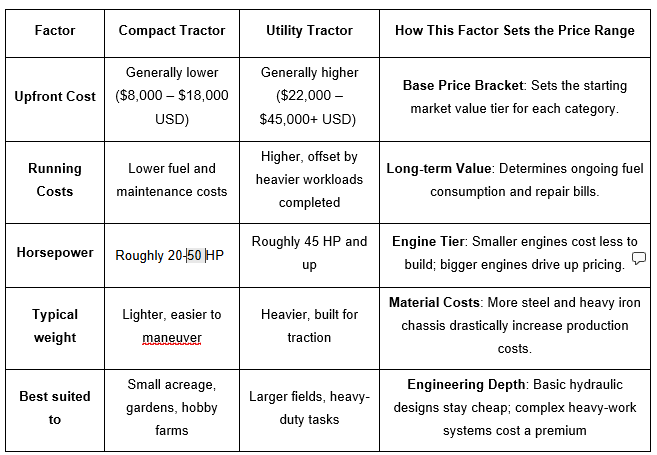
Choosing a tractor based solely on a lower upfront price can lead to higher long-term costs if it cannot meet your operational needs. Factor in fuel use — this guide on how to increase tractor fuel efficiency shows how — along with dealer parts access and resale value, not just the purchase price. A well-maintained tractor in either class holds its value if it's matched to the work it actually does.
Suggested Read: Tractor Maintenance Checklist for Harvest Season
There’s no universally “better” option in the compact tractor vs utility tractor debate. It depends on your acreage, your workload, and your budget.
Match the machine to the job, not the other way round. If you're still unsure, start with your acreage and heaviest regular task, then work backward from there.
The main difference is power and weight. Compact tractors run lighter and have lower HP, while utility tractors carry more weight and have higher HP for heavier fieldwork.
A compact tractor can manage light-duty tasks like mowing and loader work. Heavy plowing or towing large loads usually requires a utility tractor’s extra power and traction.
For most small farms under 20 acres, a compact tractor is the better fit. It’s easier to maneuver and cheaper to run for lighter daily tasks.
Yes, but the higher price reflects advanced specs like high horsepower and heavy cast-iron weight. For commercial farmers, this upfront investment quickly pays off through reduced labor hours, improved fuel efficiency, and rugged durability needed to scale production
Many three-point implements fit both classes. Heavier attachments, though, need the lift capacity and PTO output that only a utility tractor provides. Its always better to check the implement fit “CAT” category for each tractor.